

Plzeňský kraj

Plzeňský kraj
Konplan s.r.o.
2026
459 800 Kč
Ing. Lucie Hájková
lucie.hajkova@plzensky-kraj.cz
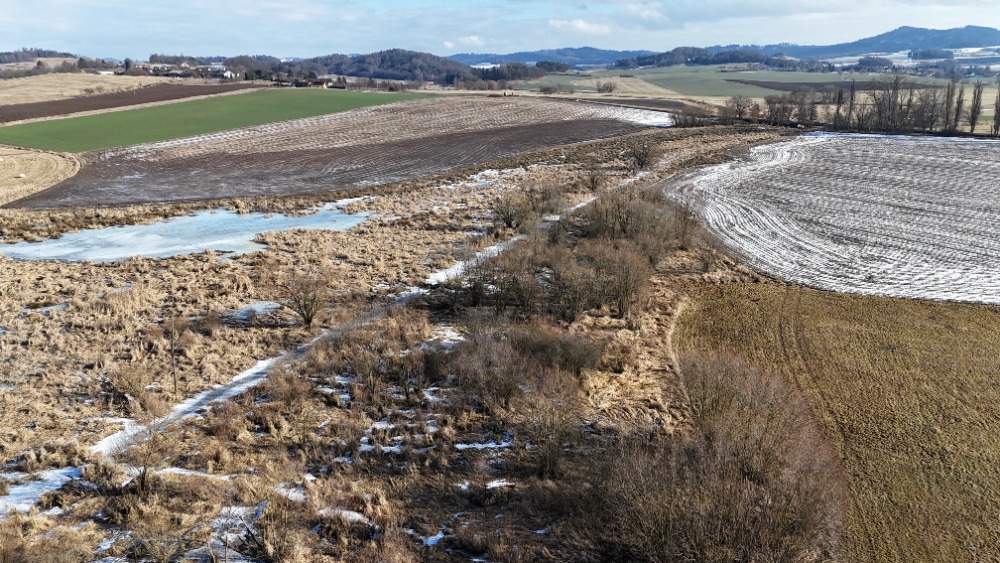
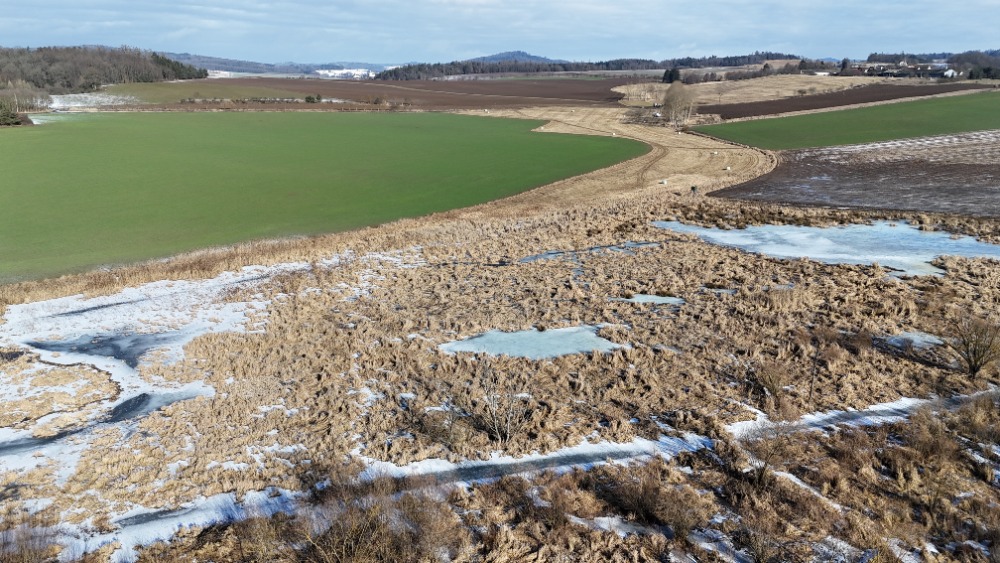
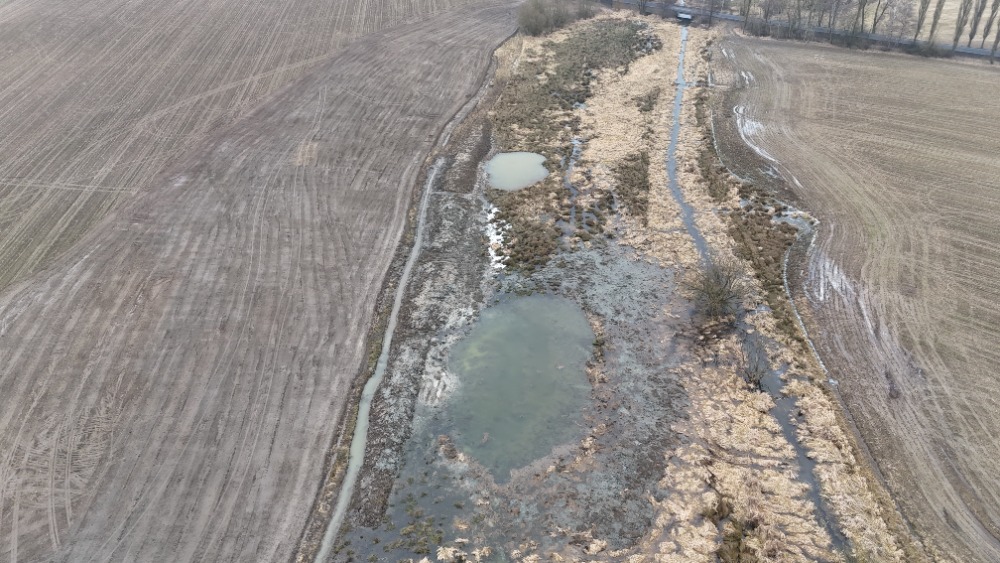
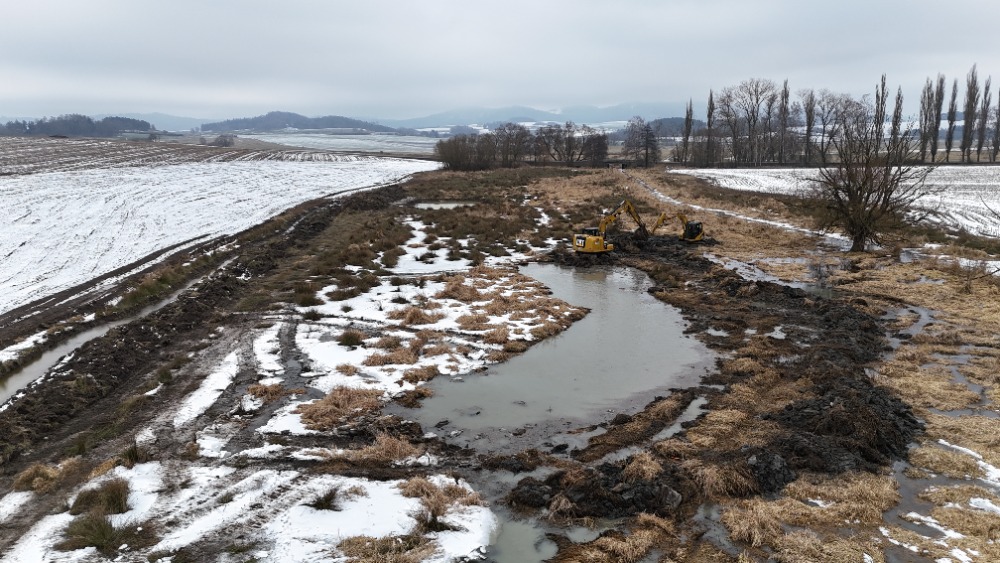
Thanks to the cooperation of the Pilsen Region with the Konplan company, the water regime of the already formed wetland near the village of Ostřetice in the Klatovy district was stabilized. This intervention has not only preserved and modified the wetland, but also prevents its unwanted expansion into the surrounding agricultural land. This will allow farming to continue on these lands.
The floodplain of the Točnický stream is inhabited by a population of the protected European beaver (Castor fiber) that lives here permanently and has created a cascade of dams. The wide floodplain of the stream has a very gentle slope and is overgrown with willows suitable for beavers. Their activity here has caused the water level to rise rapidly and water to spill onto arable land around the stream. Several years ago, water began to spontaneously change its course due to beaver dams and created a flooded or waterlogged floodplain up to 100 m wide in places. Morphologically, a meandering stream emerged here with its water level dependent on beaver activity and the amount of precipitation during the year. The flooding of the land made it impossible to farm the arable land adjacent to the stream. However, it gave rise to a habitat for a number of rare and protected animals, especially bird species of wetlands and standing waters. In order to resolve the situation, the Pilsen Region exchanged land with the original owner and user of a part of the land in the floodplain of the stream, the company Měcholupská zemědělská a.s., and now a significant part of the floodplain and wetland is owned by the Pilsen Region and can serve for nature protection purposes.
This site is very important due to the occurrence of rare bird species, such as the common crane (Grus grus), the greylag goose (Anser anser), the Eurasian bittern (Botaurus stellaris), the white-spotted blue throat (Lusciniasvecica cyanecula) and many others. In addition to the specially protected European beaver, signs of the protected Eurasian otter (Lutra lutra) have been found here. Several species of bats regularly hunt above the wetland due to the high number of insects.
The insects tied to standing water, that can be observed in the wetland, include the predatory southern hawker (Aeshnacyanea), the broad-bodied chaser (Libelluladepressa) and the banded demoiselle (Calopteryx splendens).
To preserve the biodiversity of the area, two water lagoons were stabilized in the flooded part of the floodplain at the beginning of February 2026, and a bypass channel was excavated on the border with the agricultural land, which reduces its further waterlogging. An earth embankment was shaped from the excavated material along the bodies of water, which, in addition to protecting against water erosion, also forms a protective screen for birds against disturbance from the surrounding area. The riverbed creates shallow flowing water with an exposed bank, forming an attractive habitat for a group of wading birds as well as a breeding habitat for amphibians. The implemented targeted adjustment of the water regime and stabilization of the wetland on "abandoned" arable land assumes the wetland will be occupied by amphibians, for which this environment was not yet optimal as the wetland was heavily overgrown with ruderal vegetation and was clogged with erosion material washed away from the surrounding fields. With the current general decline in the number of all amphibian species and the absence of suitable biotopes in the vicinity of Klatovy, the spread of, for example, the smooth newt, common toad, but also European tree frogs and groups of edible frogs is expected to occur in the wetland. The site will be regularly monitored also for aquatic insects and water birds.




Krajský úřad Plzeňského kraje
Odbor životního prostředí
Škroupova 1760/18
301 00 Plzeň
IČO: 70890366


